Sunday, September 24, 2006

Lesson in Honor from the Military

Somewhere along the line the people who run this country failed to learn some valuable lessons about honor and integrity. What is stupefying about that is for all of the "reverence" they have for the military, they've never seemed to absorb any of the morals to the stories they love to tell. The fact that so many retired officers have spoken out in the last 2 years should be telling them something, but it isn't. What are they missing?

The retired officers believe that the negative consequences of the president's anti-terror policies could have been avoided if the administration had followed traditional military practices. Retired Marine Maj. Gen. Fred E. Haynes, 83, is a veteran of World War II and the Korean and Vietnam wars. In 1945, he was a captain in the regiment that seized Mt. Suribachi on Iwo Jima and raised the U.S. flag there. In March of that year, his unit found two U.S. soldiers dead, apparently victims of torture. On March 17, about 10 days before the battle ended, a Japanese soldier, wearing nothing but his boots and a cotton jock strap, stepped out of a cave with his hands up. He had read one of the leaflets Americans were distributing in artillery shells that promised that anyone who gave up would get his wounds treated and his stomach filled.


The Moral?

"The moral of the story," said the general, "is we Americans have been so thoroughly imbued with the idea that you have to treat prisoners humanely — and this [story] is an example of why. It is an illustration of how by treating an individual decently you are much more likely to get any information you might want — and it's more likely to be correct."


How are things done today?

Retired Brig. Gen. James P. Cullen was chief judge of the U.S. Army Court of Criminal Appeals. "I grew up in an Army where the rules were very clear and where serviceman and women had no question about what their obligations and responsibilities were under both the Geneva Convention and our domestic law," he said. "When you have a winking-and-nodding policy [as was the case at Abu Ghraib], that just brings about the consequences that we came to view at [the prison]."

What further fuels the officers' outrage is that the policies they believe have undermined the military were mostly formulated by men, like Bush, who have not seen combat.

"[Vice President Dick] Cheney made mention in the days after 9/11 that he wanted to operate sort of on the dark side," Cullen said. "Here was a guy who never served, and now something terrible had happened, and he wanted to show that he was a tough guy…. So he's going to operate outside the rules of law. Bad message."


Maybe if the administration spent more time listening to them and less parading them around like show ponies they could learn something.

Instant Terrorist, Just Add Ill-Conceived War

A leaked intelligence document shows that instead of fighting and destroying the terrorist threat with the war in Iraq, instead the opposite is occurring.

"They conclude that the Iraq war has made it worse," said a government official familiar with the document who spoke on condition of anonymity because of its classified nature.

"It paints a fairly stark picture of what we all know, and that this is a movement that is spreading and gaining momentum around the world," said the official familiar with the document. "Things like the Iraq war have given the terrorists recruiting tools and places to ply their trade and a training ground."


It will be interesting to see how the GOP and the White House try to spin this, explicit acknowledgement by it's own people that the war has in fact not made the world safer from terrorism. My guess is they'll try and attack the leak first, before eating their own.

Friday, September 22, 2006

Thursday, September 21, 2006

Dubai Still Owns US Ports?

From NPR:

Six months ago, Dubai Ports World reached an agreement with Congress to sell its North American operations to a U.S.-based firm within four to six months. Six months later, the company still owns those ports, but says it will sell soon. Democrats say they will make it a campaign issue if a sale isn't completed before the November elections.
(Link includes audio.)

So apparently the GOP's plans to improve border security is to allow foreigners to own our ports, but not vote in our elections. I feel safer already.

Wednesday, September 20, 2006

They Come Here to Vote?

You know the Republicans in Congress are out of touch with reality, I know it, we all know it. But I'm still astounded at the ways in which they find to demonstrate this.

The House and the Senate moved yesterday toward a piecemeal crackdown on illegal immigration, pushing forward separate bills to require photo identification to vote, build vast fences on the U.S.-Mexico border and speed the deportation of undocumented workers.


Whatever you think about illegal immigration, I think most sane people would agree that nobody comes here so they can vote. I'm guessing the jobs are a big reason, not the chance to choose the next township constable in Marion county (yeah somehow they still have them).

So are they crazy or crazy like a fox? Sure the photo ID bill was upheld in Indiana (so far) its been struck down in Georgia and Missouri. And with the furor over immigration, we have an environment similar to the time when the PATRIOT Act was passed where reasonable dissent is seen as weakness. So it looks like the GOP has pulled a fast one, launching Strom Thurmond's revenge on the electorate in the name of national security, and getting away with it right? I have faith that the voters will see through this, they'll realize that this has nothing to do with their safety. They may not see the wrong being perpetuated by disenfranchising voters, but they'll see that this is the most hollow of security measures.

Sunday, September 17, 2006

Spy for Hire?

The La Times today has an article on how the US intelligence operations are now largely dependent upon private contractors. Not just for operational support, or technology, but intelligence gathering. It would appear that it has gotten to the point where the agencies can't even control the situation.

The proliferation of contractors has outstripped the intelligence community's ability to keep track of them.

Former intelligence officials said most U.S. spy agencies did not have even approximate counts of the numbers of contractors they were employing — although several officials said the number at the CIA had nearly doubled in the last five years and now surpassed the full-time workforce of about 17,500.


"So What" you say?

"We have to come to some conclusion about what our core intelligence mission is and how many [full-time employees] it's going to take to accomplish that mission," Sanders said, adding that the growth in contracting over the last five years had been driven by necessity and was extremely haphazard.

"I wish I could tell you it's by design," he said. "But I think it's been by default."

Senior U.S. intelligence officials said that the reliance on contractors was so deep that agencies couldn't function without them.
"If you took away the contractor support, they'd have to put yellow tape around the building and close it down," said a former senior CIA official who was responsible for overseeing contracts before leaving the agency earlier this year.


Do we really want to create an environment where its pay for play on national security? If the administration is doing everything it can to make the nation more secure, then why has it allowed the intelligence agencies to wither on the vine to the point that they need this much outside help?

Friday, September 15, 2006

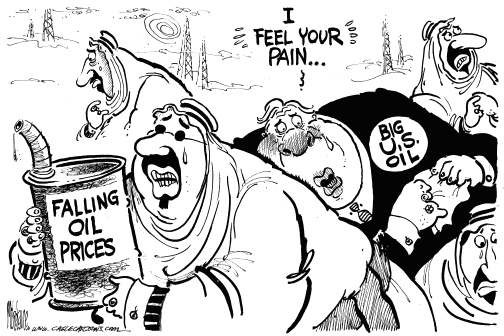
I Feel Your Pain


The week in political cartoons.

Thursday, September 14, 2006

Have We Run Out of Troops?

In an op-ed appearing in the Washington Post this week William Kristol and Rich Lowery called on the White House to send more troops to Iraq. Calling for a return to the show of overwhelming force that has been a trademark of the US military since the Whiskey Rebellion (Washington personally lead 13,000 troops, a force nearly the size of the entire Revolutionary Army) would seem like common sense. We can't leave Iraq unstable, but we can't stabilize it with current troop levels. So whats the catch?

According to in-house assessments, fully two-thirds of the Army's operating force, both active and reserve, is now reporting in as "unready"—that is, they lack the equipment, people, or training they need to execute their assigned missions. Not a single one of the Army's Brigade Combat Teams—its core fighting units—currently in the United States is ready to deploy. In short, the Army has no strategic reserve to speak of.


The White House's reaction?
One remarkable aspect of the current disarray is how the administration has refused to face up to the problem. The military's funding requests to improve readiness were reduced by the Office of the Secretary of Defense when the Pentagon was putting together its budget request because of the costs of operations in Iraq and, to a much lesser degree, in Afghanistan. (Those costs are the major reason why the current national defense spending of $562 billion is higher in dollar terms than in any other year since World War II except 1952, the height of the Korean War buildup.) On top of that, the Office of Management and Budget cut nearly $5 billion more from the budget submission that emerged from the Pentagon.


So in a world where Afghanistan isn't yet stable, Iran wants the bomb, and North Korea has it, we're tapped out. Is this supposed to be how we make the US safer from terrorist? Do we really believe that our current strategy is going to defeat terrorism?

"Bad Presidents Happen to Good People"

Video of Bill Maher's appearance on Hardball last night.

Wednesday, September 13, 2006

Voting Machine Irregularities in Ohio? That's Unpossible!

In the first thorough study of a paper-backed system -- often seen as an answer to concerns about touch-screen voting -- the nonpartisan Election Science Intistute (sic) found that about 10 percent of the paper ballots sampled were uncountable. And in Ohio, that's a big problem: The paper ballot is the official ballot if there's a recount.


If Diebold's ATM machines failed to record a transaction 10% of the time they'd be out of business, and would have the Feds breathing down their necks. But voting machines fail? Meh. I'm not a conspiracy theorist, I think incompetence can explain most things like this, but do we really want incompetence deciding an election?